Quantum-Resistant Encryption in 2026: OpenSSH Updates
US organizations are proactively updating OpenSSH configurations to implement quantum-resistant encryption by 2026, a critical move to prepare for the inevitable advent of quantum computers capable of breaking current cryptographic standards.
The digital landscape is on the cusp of a monumental shift, driven by the looming threat of quantum computing. Understanding why US organizations are updating OpenSSH configurations today for quantum-resistant encryption in 2026 is paramount for safeguarding sensitive data against future cryptographic vulnerabilities.
The looming quantum threat and its impact on current encryption
The dawn of quantum computing, while promising revolutionary advancements, also casts a long shadow over the security of our digital world. Current cryptographic algorithms, the bedrock of online security, are vulnerable to the immense processing power of future quantum machines. This section explores the fundamental nature of the quantum threat and why it necessitates an urgent re-evaluation of existing encryption protocols.
Understanding quantum supremacy and its cryptographic implications
Quantum computers operate on principles vastly different from classical computers, leveraging phenomena like superposition and entanglement. This allows them to perform certain calculations exponentially faster, notably Shor's algorithm, which can efficiently break widely used public-key cryptography like RSA and ECC. The cryptographic implications are profound, threatening the confidentiality and integrity of virtually all digital communications and stored data.
- Shor's Algorithm: A quantum algorithm capable of factoring large numbers and solving discrete logarithm problems, which underpin RSA and ECC respectively.
- Grover's Algorithm: While not as immediately threatening to asymmetric cryptography, it can speed up brute-force attacks on symmetric keys and hash functions.
- Harvest Now, Decrypt Later: The concern that adversaries are already collecting encrypted data, intending to decrypt it once quantum computers become powerful enough.
The potential for quantum computers to render current encryption obsolete isn't a distant fantasy; it's a future that cybersecurity experts are actively preparing for. The window of opportunity to transition to quantum-resistant solutions is shrinking, underscoring the urgency of the initiatives currently underway.
The quantum threat is not merely theoretical; it represents a tangible risk to national security, critical infrastructure, and economic stability. Organizations must recognize that the time to act is now, not when quantum computers are fully operational. Proactive measures are essential to mitigate the catastrophic consequences of a quantum attack on insecure systems.
NIST's post-quantum cryptography standardization efforts
In response to the undeniable quantum threat, the National Institute of Standards and Technology (NIST) embarked on a multi-year effort to standardize new cryptographic algorithms. These algorithms, known as post-quantum cryptography (PQC), are designed to resist attacks from both classical and quantum computers. This section details NIST's critical role in shaping the future of secure communication.
The selection process and chosen algorithms
NIST's rigorous standardization process involved multiple rounds of evaluation, inviting cryptographic experts worldwide to submit and analyze candidate algorithms. After years of intense scrutiny, NIST announced the initial set of standardized PQC algorithms, marking a significant milestone in the journey towards quantum-resistant security.
- CRYSTALS-Kyber: Selected for key encapsulation mechanisms (KEMs), crucial for establishing secure sessions.
- CRYSTALS-Dilithium: Chosen for digital signatures, essential for authenticating identities and data integrity.
- SPHINCS+: An alternative digital signature scheme, offering a different security trade-off.
These algorithms represent a diverse range of mathematical approaches, aiming to provide robust security against various quantum attack vectors. The selection process prioritized not only security but also performance, ensuring that these new algorithms could be practically implemented in real-world systems without undue overhead.
NIST's ongoing work includes further evaluation of additional PQC candidates for future standardization, recognizing the importance of cryptographic diversity and resilience. This continuous effort ensures that the cryptographic community remains agile and responsive to evolving threats and technological advancements. The standardization provides a clear roadmap for organizations to begin their transition.
OpenSSH and its role in secure remote access
OpenSSH is a ubiquitous tool, providing secure remote access to servers and other network devices. Its widespread adoption makes it a critical component in the cybersecurity posture of countless organizations, particularly in the US. Understanding OpenSSH's functionality and its current cryptographic dependencies is key to appreciating the impact of the quantum-resistant transition.
How OpenSSH currently secures connections
OpenSSH relies on strong cryptographic primitives to establish secure, encrypted communication channels. It uses a combination of symmetric encryption, asymmetric encryption (public-key cryptography), and cryptographic hashing to protect data in transit and authenticate users and hosts. This multi-layered approach has historically made OpenSSH a robust solution for remote administration and file transfer.
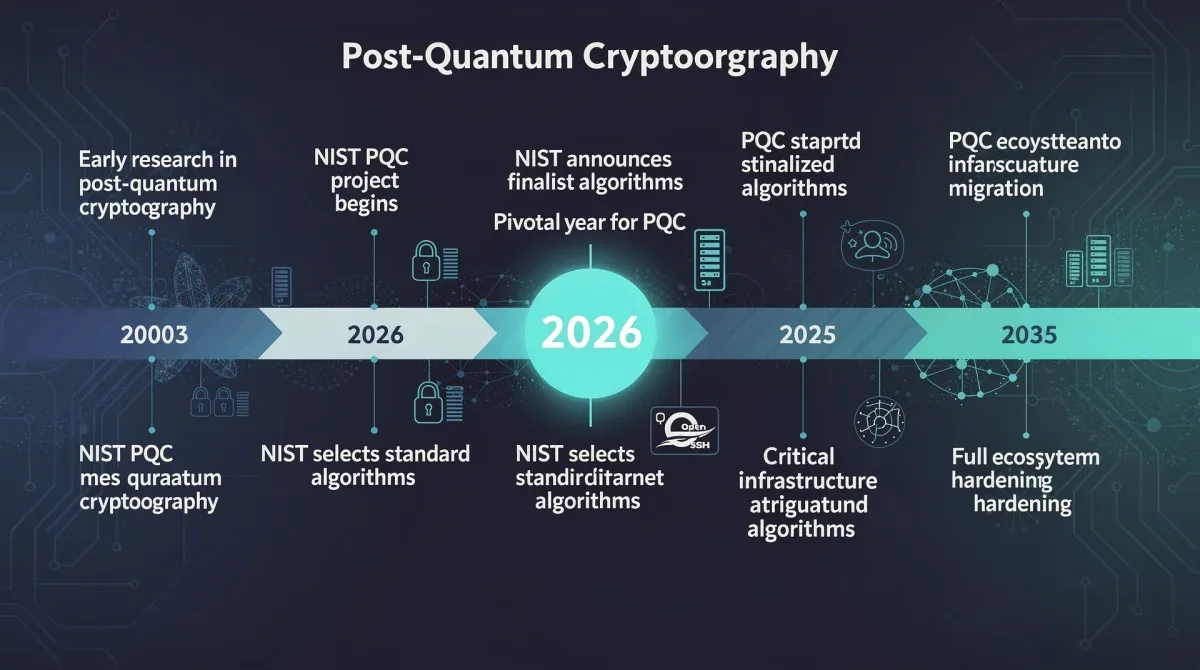
The core components of OpenSSH's security include:
- Key Exchange Algorithms: Such as Diffie-Hellman, which establish a shared secret key over an insecure channel.
- Symmetric Ciphers: Like AES, used to encrypt the actual data traffic once a shared secret is established.
- Public-Key Authentication: Often using RSA or ECC keys for user and host authentication.
- Hashing Algorithms: For data integrity checks and key derivation.
The reliance on algorithms like Diffie-Hellman, RSA, and ECC for key exchange and authentication is precisely why OpenSSH configurations are at risk from quantum computers. These are the algorithms that Shor's algorithm can efficiently break, compromising the foundational security of OpenSSH connections. The urgency stems from the need to replace these vulnerable components with their quantum-resistant counterparts.
OpenSSH's open-source nature facilitates rapid development and community-driven security enhancements. This collaborative environment is crucial for integrating new PQC algorithms efficiently and ensuring that the transition to quantum-resistant OpenSSH is as smooth and secure as possible for all users.
The imperative for US organizations to update OpenSSH by 2026
The year 2026 is emerging as a critical deadline for US organizations to implement quantum-resistant encryption, particularly within their OpenSSH configurations. This urgency is driven by a confluence of factors, including government mandates, the accelerating pace of quantum research, and the 'harvest now, decrypt later' threat.
Government directives and industry best practices
US government agencies are leading the charge, recognizing the national security implications of cryptographic vulnerability. Directives from bodies like the National Security Agency (NSA) and NIST are pushing federal agencies to begin their transition to PQC. These mandates often serve as a benchmark for private sector organizations, influencing industry best practices and setting expectations for cybersecurity resilience.

The private sector, especially in critical infrastructure, finance, and healthcare, is also feeling the pressure. Failure to update could expose sensitive data to future quantum attacks, leading to significant financial losses, reputational damage, and regulatory penalties. The proactive adoption of PQC is not just about compliance; it's about maintaining operational integrity and customer trust.
Moreover, the supply chain implications are vast. Organizations must ensure that their vendors and partners are also making the transition to quantum-resistant encryption. A single weak link in the chain could compromise the security of an entire ecosystem. This necessitates a collaborative approach to cybersecurity, extending beyond individual organizational boundaries.
The 2026 timeline is not arbitrary; it reflects expert projections on when sufficiently powerful quantum computers could emerge. While the exact date is uncertain, the prudent approach is to prepare well in advance, minimizing the risk of a sudden cryptographic collapse. Organizations that delay their transition risk being caught unprepared, facing immense challenges in retrospectively securing their systems.
Practical steps for updating OpenSSH configurations
Migrating OpenSSH configurations to incorporate quantum-resistant encryption requires careful planning and execution. This section outlines the practical steps organizations can take to ensure a smooth and secure transition, minimizing disruption while maximizing future security.
Migration strategy and testing
A successful transition begins with a comprehensive migration strategy. This involves inventorying all OpenSSH instances, assessing their current configurations, and identifying dependencies. It's crucial to prioritize critical systems and establish a phased rollout plan, allowing for thorough testing at each stage. Testing in a non-production environment is paramount to identify and resolve any compatibility issues or performance bottlenecks before deployment.
- Inventory Assessment: Catalog all servers, devices, and applications relying on OpenSSH for remote access or data transfer.
- Compatibility Checks: Verify that operating systems and libraries support the new PQC algorithms.
- Phased Rollout: Implement updates incrementally, starting with less critical systems, to minimize risk.
- Performance Benchmarking: Evaluate the impact of new algorithms on connection speeds and resource utilization.
Organizations should consider running OpenSSH in a 'hybrid' mode initially, supporting both classical and PQC algorithms. This allows for a gradual transition, ensuring backward compatibility while new PQC-enabled clients and servers are deployed. This dual-mode operation provides a safety net during the migration period.

Training IT staff on the new PQC algorithms and OpenSSH configurations is also vital. A well-informed team can troubleshoot issues more effectively and ensure the secure implementation of the updates. The transition is not just a technical challenge but also an educational one, requiring a deep understanding of the underlying cryptographic principles.
Challenges and considerations in the transition to PQC
The journey to quantum-resistant encryption is not without its hurdles. Organizations face several challenges, from the complexity of implementing new algorithms to the need for continuous monitoring and adaptation. Addressing these considerations proactively is essential for a successful and resilient PQC transition.
Performance, interoperability, and algorithm agility
One primary concern is the performance overhead associated with some PQC algorithms. While NIST has prioritized efficiency, certain PQC algorithms may require more computational resources or introduce latency, especially in resource-constrained environments. Organizations must carefully evaluate the trade-offs between security and performance for their specific use cases.
Interoperability is another significant challenge. Ensuring that PQC-enabled OpenSSH clients can communicate seamlessly with PQC-enabled servers, and that different PQC implementations can interact correctly, is crucial. This necessitates adherence to standards and rigorous testing across diverse platforms and vendor solutions. The fragmentation of implementations could hinder widespread adoption.
Furthermore, the field of quantum cryptography is still evolving. While NIST has standardized initial algorithms, research is ongoing, and new algorithms or vulnerabilities may emerge. Organizations need to build 'algorithm agility' into their systems, allowing for easy updates and replacements of cryptographic primitives as the threat landscape changes. This means avoiding hardcoding specific algorithms and designing systems with modular cryptographic components.
The cost of transition, including software upgrades, hardware replacements, and staff training, can also be substantial. Organizations need to budget adequately for these expenses and communicate the long-term benefits of PQC investment to stakeholders. While the initial outlay may seem significant, the cost of a quantum breach would undoubtedly be far greater.
The transition to quantum-resistant encryption is a complex, multi-faceted undertaking. It requires a combination of technical expertise, strategic planning, and a commitment to continuous adaptation. However, the long-term security benefits far outweigh the challenges, positioning organizations for a more resilient and secure digital future.
| Key Point | Brief Description |
|---|---|
| Quantum Threat | Future quantum computers can break current encryption (RSA, ECC), necessitating new algorithms. |
| NIST PQC Standards | NIST has standardized new algorithms (Kyber, Dilithium) to resist quantum attacks. |
| OpenSSH Updates | US organizations are updating OpenSSH to integrate quantum-resistant algorithms by 2026. |
| Migration Challenges | Performance, interoperability, and the need for algorithm agility are key considerations. |
Frequently asked questions about quantum-resistant encryption and OpenSSH
Why is quantum-resistant encryption necessary for OpenSSH?▼Quantum-resistant encryption is essential because current OpenSSH cryptographic algorithms, like RSA and ECC, are vulnerable to attacks by future quantum computers. Updating ensures secure remote access and data protection against these advanced threats, preventing potential breaches and maintaining data confidentiality.
What is the significance of 2026 for these updates?▼The year 2026 is a projected deadline for US organizations to transition to quantum-resistant encryption. This timeline is driven by government mandates, the rapid advancement of quantum computing, and the 'harvest now, decrypt later' threat, urging proactive measures before quantum computers become a practical reality.
Which NIST-standardized algorithms are relevant for OpenSSH?▼NIST has standardized algorithms like CRYSTALS-Kyber for key encapsulation mechanisms and CRYSTALS-Dilithium for digital signatures. These are crucial for replacing vulnerable components in OpenSSH's key exchange and authentication processes, providing robust security against quantum attacks.
What are the main challenges in updating OpenSSH for PQC?▼Key challenges include managing potential performance overheads from new algorithms, ensuring interoperability across diverse systems, and maintaining algorithm agility to adapt to future cryptographic advancements. Organizations also face significant costs and the need for extensive staff training.
How should organizations approach the OpenSSH PQC migration?▼Organizations should start with a comprehensive inventory of OpenSSH instances, develop a phased migration strategy, and conduct thorough testing in non-production environments. Implementing a 'hybrid' mode, supporting both classical and PQC, can facilitate a smoother transition while ensuring backward compatibility.
Conclusion
The transition to quantum-resistant encryption in OpenSSH configurations by 2026 represents a pivotal moment in cybersecurity for US organizations. Facing the imminent threat of quantum computers, proactive adoption of NIST-standardized post-quantum cryptography is not merely a recommendation but a critical imperative. While challenges such as performance, interoperability, and the need for algorithm agility exist, the long-term security and resilience against future quantum attacks far outweigh the complexities of this transition. Organizations that embrace these updates now will be well-positioned to safeguard their data and maintain trust in an increasingly quantum-influenced digital world.
